
Disclosure: This post contains affiliate links. We may earn a commission at no extra cost to you. Our research is independent and unbiased.
Editorial Note: This article was researched with AI assistance and reviewed by licensed veterinary and insurance professionals before publication.
Indoor Cat Insurance: Why 'Safe' Cats Still Rack Up $4,000 Vet Bills
Think your indoor cat doesn't need insurance? After 15 years in the ER, I can tell you exactly why house cats still need coverage to avoid economic euthanasia.

Alex Carter
Veterinary Medicine Expert
“But he never goes outside. He’s totally safe.”
If I had a dollar for every time a sobbing owner said this to me across the stainless steel counter of an emergency vet clinic at 3:00 AM, I could have retired a decade ago.
There is a massive misconception that keeping a cat indoors wraps them in a protective bubble of invincibility. It’s true that your living room protects your cat from coyotes, speeding cars, and feline leukemia passed around by neighborhood strays. But after 15 years working as a veterinary assistant in high-volume animal ERs, I need to be blunt with you: the indoors comes with its own set of life-threatening hazards.
And when those hazards strike, they are expensive. Every week, I watch owners face “economic euthanasia”—the devastating choice to put a beloved, fixable pet to sleep simply because the owner cannot afford a $4,000 surgery.
You don’t want to be the person crying in Exam Room 3 while your CareCredit application gets declined. Here is exactly why indoor cats end up on my triage table, what we have to do to save them, and why pet insurance is your only real safety net.
The “Blocked Tom”: An Indoor Cat Nightmare
If you have a male indoor cat, you need to know about Feline Lower Urinary Tract Disease (FLUTD), specifically urethral obstructions. This is a medical emergency that kills cats in agonizing pain within 48 to 72 hours if left untreated.
Indoor cats are highly susceptible to this. They live sedentary lives, often eat dry kibble, and are incredibly sensitive to environmental stress. This combination leads to crystals and mucus forming in their bladder, which creates a gritty plug that gets lodged in their narrow urethra.
You’ll hear them crying in the litter box. You’ll see them straining, producing maybe a single drop of bloody urine. They will lick their genitals obsessively.
When you rush them to the ER, their bladder is the size and hardness of a baseball. Their kidneys are failing, and their potassium levels are spiking to a point that will stop their heart.
The Medical Reality (and the Bill)
Fixing a blocked cat isn’t just giving them a pill. We have to heavily sedate your crashing, critically ill cat. We pass a rigid catheter into the tip of the penis to forcefully flush the gritty plug back into the bladder. Once the pathway is clear, we suture a urinary catheter to their prepuce (foreskin) so it stays in place for 48 to 72 hours while their bladder flushes out the blood and sludge.
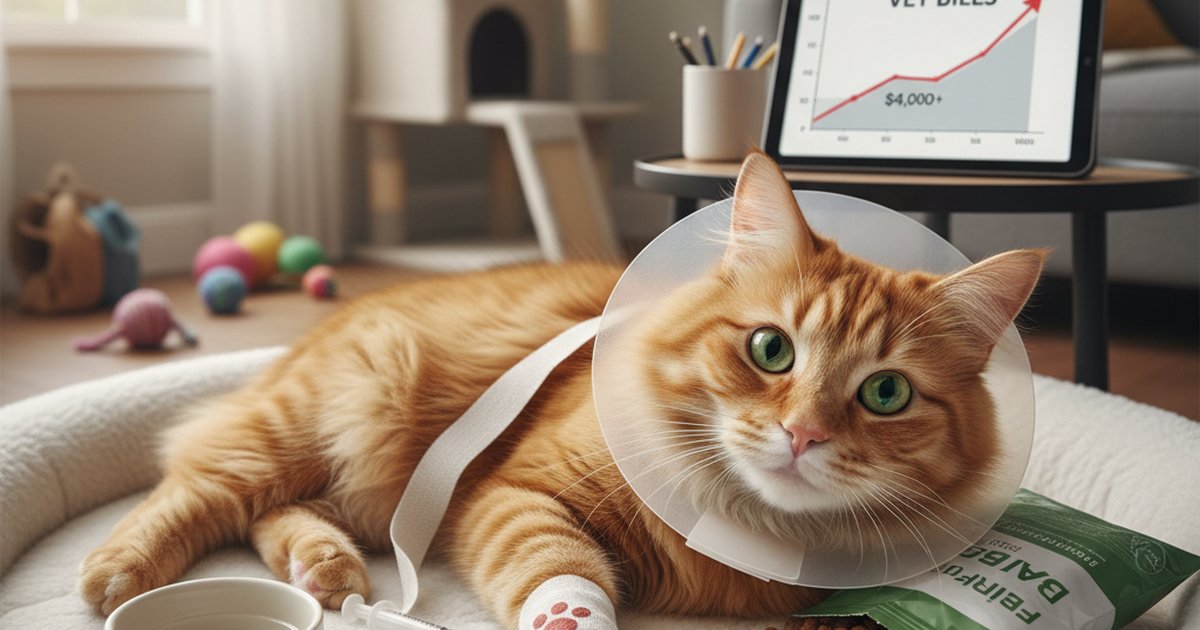
Your cat will live in an oxygen cage on IV fluids, wearing an Elizabethan collar, miserable and heavily medicated.
The cost: Expect an estimate between $2,500 and $4,500 depending on how long they need hospitalized care. If they re-block and require a Perineal Urethrostomy (a surgery that amputates the penis to widen the urinary opening so they can freely pee), add another $3,000 to $5,000.
If you have a policy with Trupanion or Lemonade, you pay your deductible and a fraction of the cost. If you don’t, and you don’t have the cash, I am the one who has to hold your cat’s paw while the doctor administers the euthanasia solution.
The Linear Foreign Body: Death by String
Indoor cats get bored. And bored cats put things in their mouths.
The most terrifying thing an indoor cat can eat isn’t a solid object; it’s string. Hair ties, sewing thread, tinsel, dental floss, and yarn. We call this a “linear foreign body.”
When a cat swallows a piece of thread, one end often gets anchored under their tongue or at the base of their stomach. The rest of the string trails down into the intestines. The intestines try to do their job, using muscular waves to push the string out. But because it’s anchored at the top, the intestines just bunch up around the string like a tight fabric scrunchie.
As the intestines squeeze against the taut string, the string acts like a cheese wire. It slowly saws through the bowel walls, leaking toxic feces directly into your cat’s abdomen.
The Medical Reality (and the Bill)
This requires immediate abdominal exploratory surgery. The veterinarian has to slice open your cat’s belly, pull out the angry, purple, bunched-up intestines, and make multiple incisions along the bowel to milk the string out piece by piece. If the string has already cut through and the tissue is necrotic (dead), we have to amputate that section of the intestine and sew the healthy ends back together.
The cost: $3,500 to $6,000+.
I have seen owners empty their children’s college funds for this surgery. I have also bagged the bodies of cats whose owners simply couldn’t find the money. Pet insurance means you look the surgeon in the eye and say, “Do the surgery right now.”
The Slow Burn: Chronic Indoor Illnesses
It isn’t just sudden traumas that drain your bank account. Indoor cats have a high rate of obesity. Fat cats are highly prone to developing Feline Diabetes.
If your indoor cat develops diabetes, you are looking at buying specialized prescription diets, paying for vials of insulin that cost $100 to $150 a pop, and bringing the cat in for continuous blood glucose curves ($150-$250 per visit) until their dosage is regulated. Over a few years, a diabetic cat can easily cost you $5,000 out of pocket.
Then there are dental issues. Over 50% of cats over the age of three develop tooth resorption—a wildly painful condition where the body attacks its own teeth, creating bleeding holes in the enamel. The only treatment is surgical extraction under general anesthesia. A dental surgery with multiple extractions will easily hit $1,200 to $2,000 at a general practice. Policies like Embrace are fantastic for covering dental illnesses, provided you got the policy before the vet noted tartar on your cat’s chart.
How to Protect Your Cat (and Your Heart)
You buy pet insurance for the same reason you buy house insurance. You hope you never have to use it, but if a fire breaks out, you aren’t left homeless.
Do not wait until your cat is sick. Pet insurance companies do not cover pre-existing conditions. If you bring your cat to me for a urinary tract infection on Tuesday, and you buy insurance on Wednesday, they will never cover a urinary blockage for the rest of that cat’s life.
Here is my advice from the trenches:
- Get it while they are kittens. The premiums are dirt cheap (often $20-$30 a month), and they have a clean medical slate.
- Look for Direct Pay. I highly recommend Trupanion because they have software that integrates directly with many emergency vet hospitals. At 2:00 AM, we can submit a pre-approval, and Trupanion will pay us directly. You only pay your portion at the desk. No waiting weeks for a reimbursement check to clear while your credit card gathers interest.
- Pick a high deductible, high coverage plan. You don’t need insurance to pay for a $60 vaccine. You need insurance to pay the $5,000 surgery bill. Set your deductible to $500 or $1,000, and get 90% coverage for emergencies.
Your indoor cat is safe from the outside world. But they are still an animal with a complex biological system living in a house full of human objects. Things will go wrong.
When they do, you want your only worry to be whether your cat will pull through, not whether your bank account can keep them alive. Get the insurance.
Frequently Asked Questions
Is pet insurance really worth it if my cat never goes outside?
Yes. I've seen thousands of indoor cats in the ER. They don't get hit by cars, but they swallow sewing needles, develop life-threatening urinary blockages, and get diabetes. A single blocked bladder surgery costs around $3,000. Insurance pays for itself the second your cat eats a hair tie.
What is the most common emergency for an indoor cat?
For male cats, it's a urethral obstruction (blocked bladder). For both sexes, it's gastroenteritis or a foreign body obstruction—usually from eating string, toxic house plants, or pieces of plastic toys.
Which pet insurance do veterinary hospitals actually like?
From the front desk perspective, we love Trupanion because they can often pay the hospital directly at checkout. Embrace and Pets Best are also highly reliable when our clients submit claims for reimbursement.