
Disclosure: This post contains affiliate links. We may earn a commission at no extra cost to you. Our research is independent and unbiased.
Editorial Note: This article was researched with AI assistance and reviewed by licensed veterinary and insurance professionals before publication.
Pet Insurance for the Toyota Tacoma Lifestyle: Protecting Your Off-Road Co-Pilot
You built your Tacoma for the trails, but is your dog protected for the ride? A veteran ER vet tech's blunt guide to off-road injuries and pet insurance.

Alex Carter
Veterinary Medicine Expert
It’s 2:00 AM on a Saturday. The sliding glass doors of the emergency clinic fly open, and the smell of copper, mud, and sheer panic floods the lobby. A guy in muddy hiking boots rushes in carrying a fifty-pound Blue Heeler wrapped in a blood-soaked beach towel.
“She jumped out of the truck,” he stammers, his voice cracking. “We were packing up the campsite. She just jumped out of the Tacoma, landed weird, and started screaming.”
As a veterinary assistant with 15 years in high-volume ERs, I’ve seen this exact scenario play out hundreds of times. If you drive a Toyota Tacoma, chances are you didn’t buy it to commute to a cubicle. You bought it for the dirt roads, the dispersed camping, the lifted suspension, and the freedom. And you bring your dog.
But here is the ugly, unvarnished truth about the adventure dog lifestyle: it is incredibly dangerous. And while you might happily drop $4,000 on a rooftop tent or a new set of all-terrain tires, I watch owners completely break down when I slide a $6,000 surgical estimate across the counter for a shattered leg.
You insure your truck. You need to insure the dog riding shotgun in it. Here is exactly what you are up against when you take your dog off-road, and why pet insurance is the only thing standing between you and the worst decision of your life.
The Orthopedic Nightmare: The “Tacoma Jump”
Let’s talk about knees. Specifically, the Cranial Cruciate Ligament (CCL), which is the canine equivalent of the human ACL.
A lifted Toyota Tacoma sits high off the ground. When your dog excitedly launches themselves out of the cab or the truck bed, they hit the dirt with a massive amount of force. All it takes is landing on an uneven rock or a slight twist of the leg, and pop.
In the ER, we don’t just see a limp. We see a joint that has completely lost its structural integrity. When the CCL tears, the dog’s femur essentially slides off the back of the tibia every time they put weight on it. It’s bone grinding on bone, often shredding the meniscus—the shock-absorbing cartilage in the knee—like pulled pork.
Fixing this isn’t a matter of a splint and some rest. It requires a TPLO (Tibial Plateau Leveling Osteotomy) surgery. We literally take a curved bone saw, cut the top of your dog’s tibia completely off, rotate the bone to change the angle of the joint, and screw a heavy-duty steel plate into the leg to hold it together.
The Cost: A TPLO surgery runs between $5,500 and $7,500 per knee. And here is the kicker: 50% of dogs who blow one knee will blow the other one within a year because they overcompensate.
If you have a policy with Trupanion or Pets Best, they cover 90% of this. You pay your deductible, and your dog gets the gold-standard surgery to get back on the trails. Without it? I’ve watched owners max out high-interest credit cards, or worse, ask us to euthanize an otherwise perfectly healthy three-year-old dog simply because they couldn’t afford the surgery. We call it “economic euthanasia,” and it is the single most soul-crushing part of my job.
Trail Trauma and Toxins
When you take your Tacoma deep into the backcountry, you are miles away from the nearest emergency vet. The hazards your dog faces out there are brutal.
Rattlesnake Bites
Dogs explore the world with their noses. When they stick their snout into a bush and find a rattlesnake, the bite is usually right on the face or neck. The venom causes immediate, violent tissue necrosis (cell death). The dog’s face swells up like a balloon, their airway starts to close, and their blood loses the ability to clot. They bleed from their gums and their IV sites.
To save them, we have to push antivenin. A single vial of antivenin costs the hospital a fortune, which means it costs you even more. The Cost: $1,500 to $2,500 per vial. Many dogs need two or three vials, plus days of hospitalization, plasma transfusions, and pain management. A bad snakebite will easily hit $6,000.
Impalements and Lacerations
Dogs running full speed through the brush don’t always see the broken branch sticking out of the ground. I have helped pull sticks out of dogs’ chests, armpits, and abdomens.
If a stick punctures the chest cavity, the negative pressure is lost, and the dog’s lungs collapse. They arrive at the clinic suffocating, their gums blue. We have to perform a thoracocentesis—stabbing a large needle through the chest wall to suck the air and blood out so the lungs can inflate—before rushing them into emergency surgery to repair the hole. The Cost: Thoracic surgery and days in the oxygen cage will run you $7,000 to $10,000.
How to Choose the Right Armor for Your Dog
If you are outfitting your Toyota Tacoma with skid plates and recovery gear, you need to outfit your dog with the right pet insurance. Not all policies are created equal, especially for high-risk, active dogs. Here is what you need to look for:
1. Watch the Orthopedic Waiting Periods
This is where owners get screwed. Many insurance companies have a standard 14-day waiting period for illnesses, but they sneak in a 6-month waiting period for knee injuries (CCL tears). If your dog blows their knee in month four, you get nothing. My advice: Look at Embrace Pet Insurance. They have a 6-month orthopedic wait, but they allow you to reduce it to just 14 days if you take your dog to a vet for a quick orthopedic exam to prove their knees are healthy when you sign up. Do this immediately.
2. Look for Direct Vet Pay
When you are staring down an $8,000 estimate at 3 AM, being told “we’ll reimburse you in two weeks” doesn’t help if you don’t have $8,000 in your checking account right now. My advice: Trupanion has software that integrates directly with many emergency hospitals. We submit the claim at the front desk, and Trupanion pays us their portion directly within five minutes. You only swipe your card for your deductible and the remaining 10%. It is a literal lifesaver.
3. Don’t Skimp on the Annual Limit
Some budget policies cap your payouts at $5,000 a year. As I just laid out, a single bad weekend on the trail will blow past that limit in 24 hours. My advice: Choose a policy with an unlimited annual payout. Lemonade, Pets Best, and Nationwide offer high or unlimited caps. When your dog is on a ventilator after a snake bite, the last thing you want to be doing is doing mental math to see if you’ve hit your insurance ceiling.
The Bottom Line
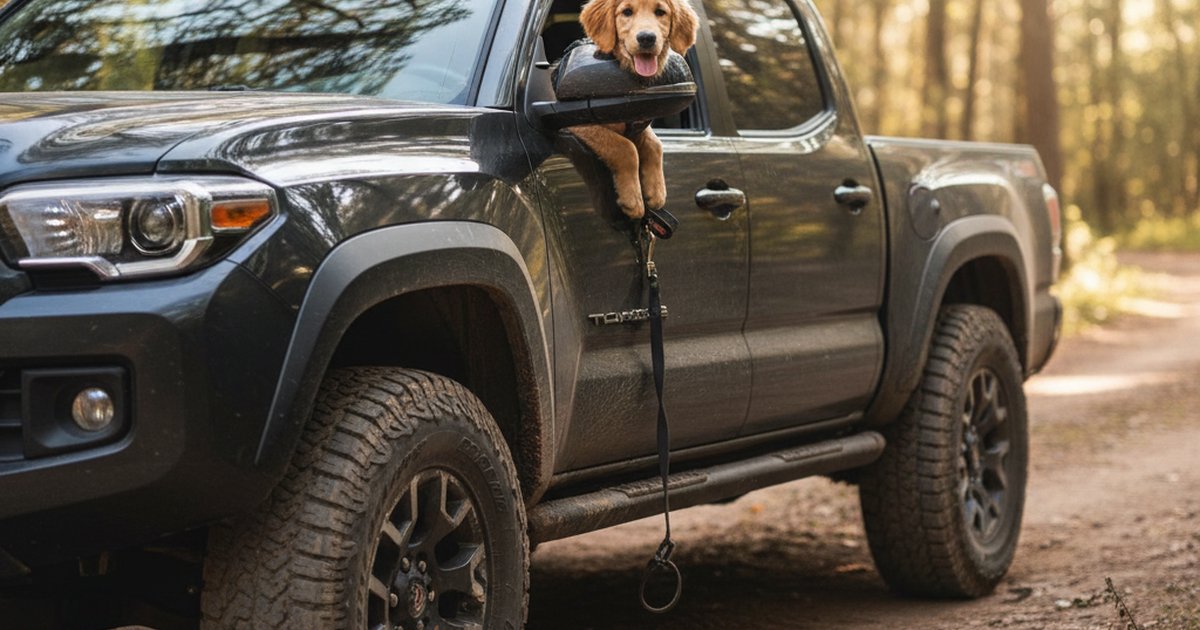
I love seeing dogs living their best lives out in the wild. A dog with their head out the window of a Toyota Tacoma, covered in mud and exhausted from a weekend in the mountains, is a beautiful sight.
But love doesn’t pay the vet bill.
I am tired of holding crying owners in the exam room while they say goodbye to a dog that could have been saved if money wasn’t an issue. Pet insurance costs roughly $40 to $80 a month depending on your breed and location. That is less than you spend on gas for a single off-road trip.
Get the insurance. Lock it in while your dog is young and healthy, before the “pre-existing conditions” kick in. Buy yourself the peace of mind knowing that no matter what happens out on the trail, or what goes wrong when they jump out of the truck, your only question to the vet will be, “When can we do the surgery?” instead of “How much is this going to cost?”
Frequently Asked Questions
My dog rides in the bed of my truck. Does pet insurance cover accidents if they fall out?
Yes, pet insurance covers trauma from falling or jumping out of a truck bed, provided the policy is active and past the waiting period. But as a vet tech, I'm begging you: secure your dog in a crash-tested kennel. I've seen too many dogs dragged by their leashes or shattered on the asphalt. Insurance pays the bill, but it doesn't reverse the suffering.
Are orthopedic waiting periods a big deal for active dogs?
They are the biggest deal. Most companies have a 6-month waiting period for knee injuries (CCL tears). If your dog blows their knee jumping out of your cab in month three of your policy, you're paying that $6,000 out of pocket. Look for companies like Embrace that let you reduce that waiting period to 14 days with an orthopedic exam from your vet.
Is pet insurance worth it if my dog is young and healthy?
That is exactly when you buy it. ERs are full of healthy, young dogs who chased a squirrel into traffic, ate a toxic mushroom on a hiking trail, or got bit by a rattlesnake. You buy insurance to protect against the unexpected trauma that happens when you're out living life. Once they are broken, it's a pre-existing condition and no company will touch it.